
Essex County Blotters Are Municipal
The sheriff's current site offers no county jail blotter. No 72-hour list appears there. No weekly one either. ECSD posts no archive depth, no schedule, no weekend rule. A city incident archive is not a county booking roster. The two should never be confused.
The real public records live at the municipal level. Lynn Police publishes dated files with Arrests kept apart from Incidents. Lawrence Police runs an archive interface whose daily logs reach back to 2013. Salem points requesters to its official records and request pages. It posts no public arrest-log archive. All of these capture police activity, which may or may not lead to county custody.
Read the Essex Police Blotter
Work backward through the dates. Keep the source label attached, because an entry only means something when the agency, record type, and incident date travel with it.
- Choose the city whose police likely made the arrest.
- Open the city’s official archive and select the Arrests category when the interface separates it from Incidents.
- Search the arrest date and nearby dates because publication may lag.
- Record the incident number, date, type, and location exactly as displayed.
- Ask the city records unit for the underlying report when the public row is too brief.
- Check ECSD separately if the person may have entered county custody.
For events from today, the Arrests Last 24 Hours page is the faster chain. The blotter approach trades speed for depth.
Lawrence Daily Log Archive
Lawrence has the deepest archive in the county. Its department says the daily logs run back to 2013. A typical public row lists an incident number. It adds the date and time, an event type, and a location. No booking number appears. No custody status, no photograph either. That field shape marks the line between police activity and jail intake.
The Lawrence Police archive lets visitors browse those official municipal daily logs by date.
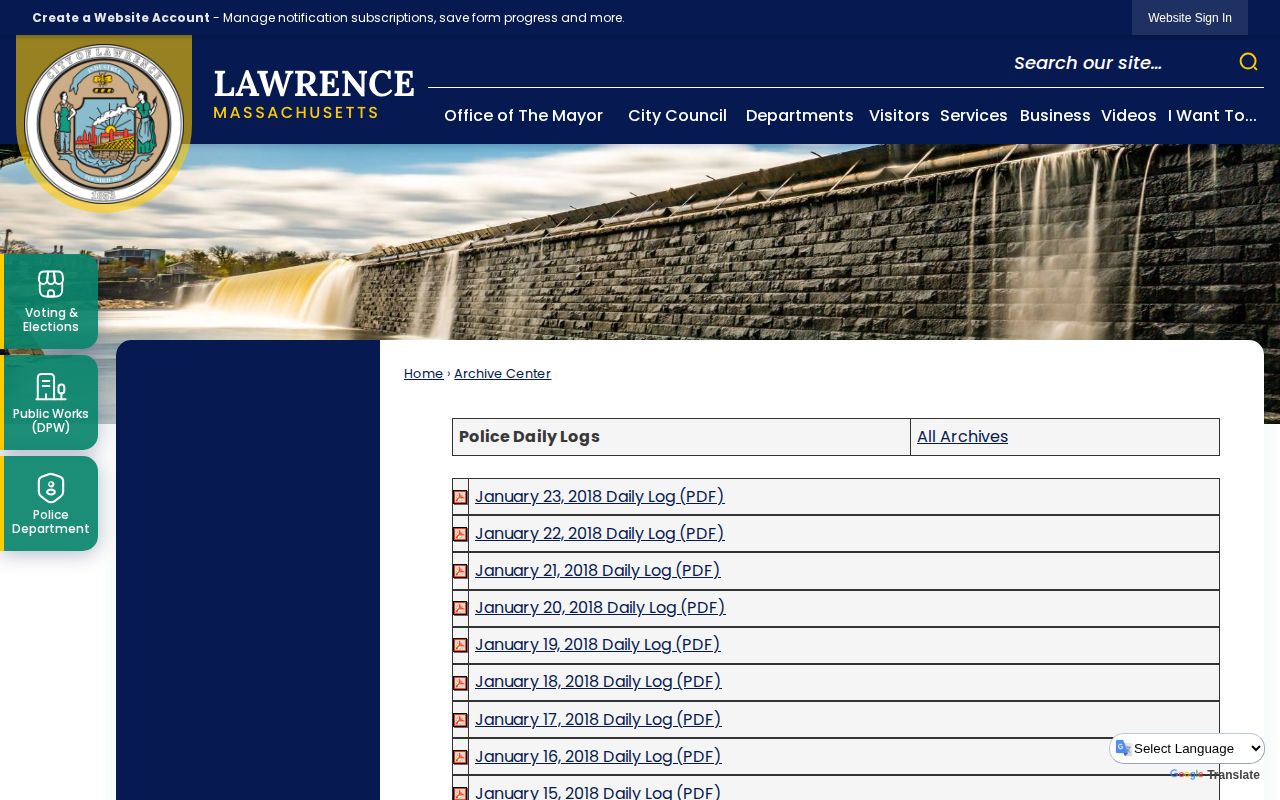
The archive page shows a multi-day browsing tool owned by the city. It can't answer questions about county custody. Use the incident number to request the matching Lawrence report. Don't assume a listed location is a home address. Don't assume an incident produced a booking. The police file and any later ECSD record are separate documents.
What Essex Log Entries Show
Fields vary by owning agency. The table follows the municipal sources as they actually publish, not some invented county format.
| Field | How to interpret it |
|---|---|
| Incident number | Municipal case key, not an ECSD booking number. |
| Date and time | Event or report timing; not necessarily jail intake time. |
| Type | Police classification that may describe an incident or arrest. |
| Location | Place tied to the logged event; read the source label. |
| Name and age | May appear in arrest summaries, particularly secondary Lynn coverage. |
| Charges | Accusations at that stage, subject to later court change. |
| Custody status | Not shown in the sampled Lawrence row; verify separately. |
| Photograph | No uniform official booking-photo display was established. |
A booking record can add more. Think facility identifier, intake time, release condition, court destination, or a transfer event. Request those details from whichever agency holds them.
Lynn Arrest Logs and Incidents
Lynn's official page draws a helpful line between categories. The "Arrests" and "Incidents" links lead to dated files. Pick the arrest material instead of treating every police call as one. The page posts no fixed weekend cadence or uniform photo policy.
Start any Lynn search with the official Lynn Police Logs. Itemlive adds secondary, near-daily reporting built on police records. The official document carries more weight. A newspaper summary can be edited, delayed, paywalled, or pulled entirely. Keep both the date and the source. If Itemlive names an arrest, check it. Weigh it against the underlying Lynn record and the later court file before concluding anything. Its articles run as text, not as a booking-photo gallery.
Local Arrest News Needs Labels
The strongest recurring secondary blotter is Itemlive, covering Lynn and the North Shore. Its police-log articles appear daily or near daily. Names, ages, residences, arrest times, and alleged charges all show up. Address details get attributed to police records. Still, it's journalism, not an ECSD feed. The sampled Itemlive Police Logs article shows the dated local-news format.
That source is local news, not an official roster or a full county arrest account. The Essex County District Attorney posts official prosecution releases. They are driven by case events rather than any daily schedule. So they skip plenty of bookings. The Salem News and Eagle-Tribune cover the region too. Their archive cadence and photo practices vary. Peabody Weekly News runs a weekly municipal log, not a county jail list.
Essex Weekend Arrest Record Gaps
Weekends stack up delays in Essex County. A city report must be finished and placed in a dated PDF. Then a person is transported, processed, and arraigned at the next court sitting. Finally the arrest gets written up in the news. No official rule compresses all that into one posting deadline. Search the adjacent dates and skip claims like "usually online within hours."
ECSD annual reports do describe overnight and weekend safekeep admissions for police agencies. That is an operational fact, not a public feed. Someone can be held briefly and released without ever landing on a county roster. No such public roster exists.
Note: A Monday file can concern a weekend event, while a weekend news story can precede the official report copy.
Essex Arrest Archives and Retention
How far back do Essex arrest records reach online? Not as far as the paper trail. Lawrence posts daily logs back to 2013, while Lynn keeps dated files and Salem offers a request path. If a log drops off the web, the underlying arrest report often survives inside the municipal system.
State rules matter here too. The Massachusetts retention schedule covers inmate and detainee case records. Some fingerprint cards and photographs count as permanent, eligible for archival transfer. Other correctional files carry set retention periods. These are records-management rules, not promises of web access; ECSD can confirm which series applies and what triggers a release.
Older Essex arrests call for direct questions. Ask the municipal custodian whether the daily log, the arrest report, and the booking photo sit in separate series. Ask ECSD whether booking records moved to electronic storage. For historic material, the Massachusetts Archives collections can help.
Confirm Essex Arrest Outcomes
A multi-day arrest log only shows the first official account. The legal story keeps moving after booking. Charges get reduced, dismissed, continued, or changed once a case reaches court. The clerk of courts holds the disposition record that settles it. Someone released from custody can drop off a jail roster. The arrest report stays on file with police.
Certain details never appear in a public log at all. Juvenile files, sealed records, and impounded material stay protected. So do victim and medical information. A blank search can also point to the wrong city or date. The Essex County recent arrests hub maps the official custodians of these records. An old third-party copy never stands in for current proof.
Public Record Search
Sponsored Results